
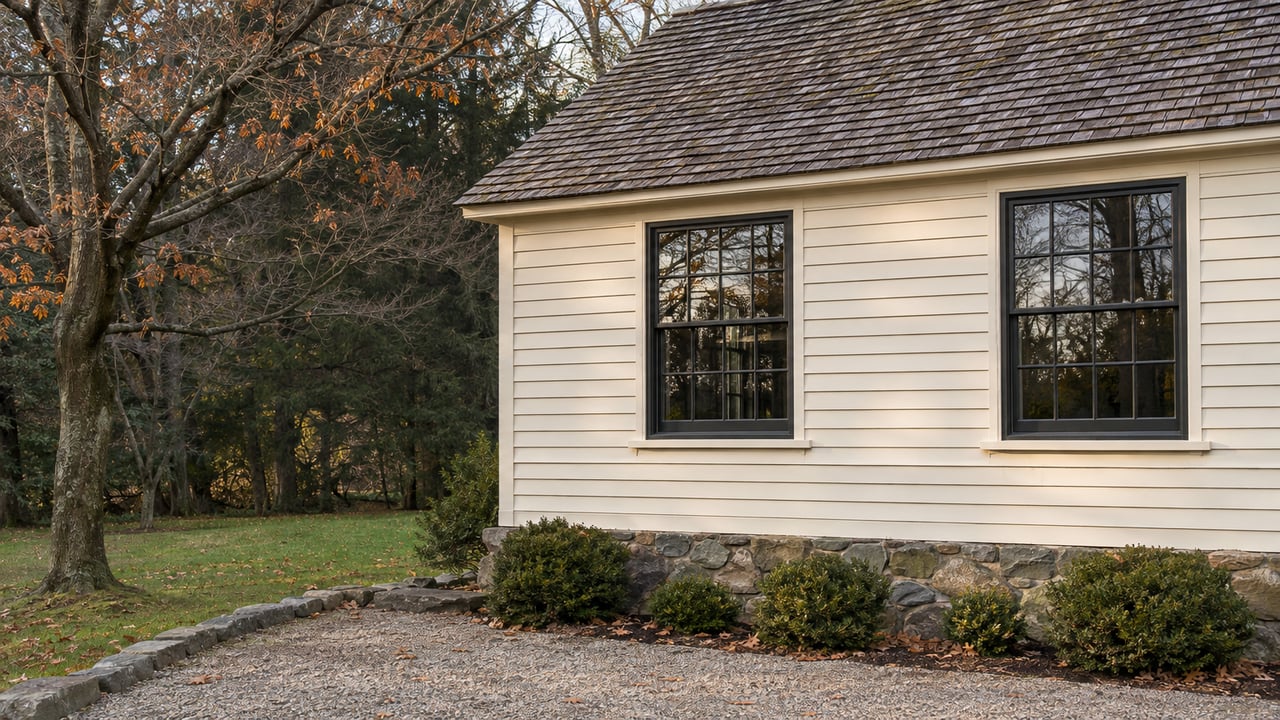
The building at 359 East Saddle River Road is where Upper Saddle River goes for heroes, paninis, hot buffet specials and catering trays. Before it was Elmer's Country Store, the site held a barn. Before that barn became a store, John Taylor, a New York haberdasher who lived in the white farmhouse just to the south, kept racehorses in it and raced them at the HoHoKus track.
Elmer's is the first stop on a short stretch of East Saddle River Road that runs north past the Lake Street corner to the Old Stone Church at 481. Each old place still standing on that stretch survived by becoming something new: the barn turned into a store, the farmhouse into a town office and then a museum, and the church into a congregation that has met for more than two centuries. The places that could not change are gone, and the Upper Saddle River Historical Society has documented them in detail.
359 East Saddle River Road: a barn that turned into a store
The change at Elmer's came from the 1929 stock market crash. According to the Historical Society's history of the store, Taylor lost his money in the crash, turned the barn into a small store and put in gas pumps. People called it The Little Store. The late John Hopper remembered that Taylor would sometimes tell customers to pump what they needed without checking. The gas was gravity-fed, and you set a lever for the number of gallons you wanted.
Later the Carlough family bought the store and set John Paterson up running the gas station. Paterson closed on Sundays to go home for lunch, and drivers waited for him to come back. The store closed during World War II. After the war Elmer Haring took it over, and the name Elmer's comes from him. Ernest and Gerda Papenhausen ran it from 1956 and lived next door in the old Taylor house. Their son Chris and his wife Linda took over in 1972.
The building you walk into today is not the original barn. The barns fell into disrepair and were judged unsafe, and Schottmeyer Bros. proposed a new building in a country style. The town approved the design after the owners worked with the Historical Society. The barns came down, some of the original clapboard siding was mounted inside the new store, and the Elmer's name stayed.
363 East Saddle River Road: the farmhouse where the town did its business
Next door, at the Lake Street corner, is the Hopper-Goetschius House. Surveyor Charles Clinton recorded it in his journal in 1739, which makes it the oldest house still standing in Upper Saddle River. It may be older still: Rosalie Fellows Bailey's book on pre-Revolutionary Dutch houses says a rough sheepskin map from about 1713 marks the site as the home of Gerrit Hoppa. The Hopper family's land reached from the Saddle River at today's Lions Park almost to Montvale.
The house changed use the way Elmer's did. The Rev. Stephen Goetschius of the Old Stone Church moved in in 1814, and his family kept the house for about 150 years. His great-great-grandson, also named Stephen Goetschius, was borough clerk for more than 40 years and ran town business from the east room. The house got electricity in 1919 but had no running water until 1962. Until then Lizzie Goetschius carried water from the well and shoveled coal for heat. In 1985 Clinton and Grace Carlough, Lizzie's nephew and his wife, gave the house to the borough. The New Jersey Historic Preservation Office lists it on both the State and National Registers.
The out kitchen, with its beehive oven and jambless fireplace, is original and may be older than the house. It was restored in 1987 by George Turrell, whom the Society found through Claire Tholl, the Upper Saddle River resident and Bergen County historian. Turrell kept the east wall with Steve Goetschius's carvings and reused the original beams. The rest of the grounds is a collection of buildings saved from other parts of town:
- The Van Riper-Tice Dutch barn, built about 1800, was taken apart on the Wulster property, moved, and rebuilt on the museum grounds in 1989 after Tholl identified it and the developer agreed to donate it.
- The Ramsey-Sayer house was moved here in 1999 and rebuilt as the schoolhouse used for school programs.
- A woodshed that once belonged to the one-room school on West Saddle River Road went first to a private home on Lake Road and was restored at the museum in 2004 and 2005.
- A storage shed from the Terhune-Hopper farm is now the blacksmith shop.
The heirloom gardens have been kept by the Society's Garden Committee since Pat Wardell formed it in 1987. The museum is open Sunday afternoons in July and August from 2 to 4 p.m., and by appointment the rest of the year. Visitors use 363 East Saddle River Road for GPS, and the Society's mailing address is 245 Lake Street. If you can't wait for July, the Society's site has a 360-degree virtual tour of the house.
Across Lake Street, at the southwest corner of Lake Street and West Saddle River Road, is the Terhune-Hopper stone house, built about 1781. It is the oldest survivor of the Terhune houses on a 330-acre tract that ran from today's Methodist Church to Hess Court. The red stucco went on around 1915, and the current owners restored the house; the Society photographed it after the restoration in 2015. It is a private home, so enjoy it from the sidewalk.
409 East Saddle River Road: the lot that had a different use in every generation
Farther north, the open land at 409 East Saddle River Road had more uses than any other property on this stretch. A thatched-roof Hopper house from about 1778 stood near the road. Around 1860 a large Gothic Revival and Italianate house replaced it, and later owners added a rubble stone veranda and a porte-cochère with fluted columns.
In the 1930s the property was Shady Lawn, a day-trip spot for city visitors with a pond and a restaurant. The only known postcard promises "Bathing…fishing…hunting…games" and invites guests to "Enjoy our special $1.00 dinner and be our guest for the day." In the 1960s James J. Coghlan ran a wholesale mail-order nursery there called The Bamboo Man, Inc. It specialized in rare plants and took part in the 1964 World's Fair through the Polynesian Village. Martin and Kathleen Wojcik bought the property next and turned the nursery into Creative Gardens shortly before 1970. They ran it for 35 years.
Unlike Elmer's and the museum, the house did not survive the end of the business. It was demolished in 2015. The borough bought the land, and the Historical Society reports that it was still undeveloped as of 2025, with plans for public space and a dog park. When Bergen County's commissioners approved their December 2022 open space grants, the list included a "Creative Gardens Tract Acquisition" for Upper Saddle River, as Patch reported. If the plan goes ahead, the next use of this lot would be public, which none of its earlier uses were.
481 East Saddle River Road: still holding Sunday services
The Old Stone Church sits at Old Stone Church Road. The church's own history says its congregation formed in 1784, built a first sanctuary in 1789, and finished the present stone sanctuary in 1819; the Historical Society's account puts that first building at 1787. The sanctuary was extensively renovated in 1971 and 1972.
The cemetery's first burial was in 1790, and the cemetery is still in use. Revolutionary-era militia veterans buried there include David Thomas Eckerson, Jacob Eckerson, John Tallman and John A. Terhune. According to the church, Rev. Stephen Goetschius, who lived in the house at 363, aided the war effort but was not a soldier. In November 2024, NorthJersey.com reported that the church had installed the Rev. Leah Ennis-Gasero as the first woman pastor in its 240-year history. In-person worship is Sundays at 10 a.m. In 2024 the Christmas Eve service was at 5 p.m., with Lessons and Carols and candle lighting.
Past the church, the same pattern
East Saddle River Road keeps going toward the New York line, and the same history continues along it. The Van Buskirk-Penner house, one of the few Revolutionary War-era stone homes left in Upper Saddle River, sits near the state border and is a private home. In the early 1900s Michael and John Connolly owned it. They started the first State Line Inn and built a half-mile trotting track roughly where the Saddle River Valley Swim and Tennis Club is today. The Penner family later ran the inn and a swim club there.
Some of the town's largest landholdings are now neighborhoods. The Carlough family farm on Carlough Road grew apples for export to 14 countries, and James D. Carlough became Upper Saddle River's first mayor in 1894. The farm became Apple Ridge Country Club in the 1960s and is now Orchard Preserve, a Toll Brothers community. Anona Park ran from 1928 to 1967 on a lake William H. Yeomans made by damming the river. Sixty-one homes were built on the land, and the lake survives as the private Anona Association beach.
The 1853 schoolhouse is a reminder of what happens to buildings that run out of new uses. It served in turn as the Borough Hall and as headquarters for the Sportsman's Club, the Fire Department, the Civil Defense Committee and the Ambulance Corps. It was demolished on September 9, 1966, when the new firehouse was built. At that point it was the oldest wood-frame schoolhouse still standing in Bergen County.
If you want the full account, the Historical Society's Lost USR page and its historic houses page cover each of these properties, and William Yeomans's Lore of Upper Saddle River is sold through the Society. For more about the town as it is today, see our Upper Saddle River neighborhood guide.
If you own an older house in Upper Saddle River, or are settling the estate of a family that has been here for generations, Jacqueline Vasquez can help you plan what comes next with care and clear numbers. Let's connect: request a home valuation or ask about our probate and estate support.