Wondering whether Upper Saddle River’s classic older homes or its limited newer builds are the better fit for you? It is a smart question, especially in a market where most homes are detached single-family properties, many were built decades ago, and truly new construction is a small share of what is available. If you are weighing charm, layout, maintenance, and long-term costs, this guide will help you think through the tradeoffs with more clarity. Let’s dive in.
Upper Saddle River Housing Context
Upper Saddle River’s housing stock leans heavily toward established homes. The borough’s 2025 Housing Element reports that 88.9% of homes are one-unit detached properties, with a median year built of 1969, and about two-thirds of the housing stock built before 1980.
That matters because your choice here is often not between two equal buckets of inventory. Only 21.0% of homes were built in 2000 or later, and just 3.8% were built in 2020 or later. In other words, if you want a true new build, you are shopping in a much smaller slice of the market.
The pricing backdrop is also important. The median owner-occupied home value was reported at $1,101,800 in 2023, and Census QuickFacts places the 2020 to 2024 median owner-occupied value at $1,108,700. In a market at this price point, the decision often comes down to how you want to allocate your budget: toward immediate convenience or toward future improvements.
What Older Charm Looks Like Here
In Upper Saddle River, older charm usually means traditional architecture and a more established feel. Current listing examples on the older-home side include updated early-1900s front-porch Colonials and classic center-hall Colonials, which often feature more formal room layouts and architectural details that newer homes may not try to replicate.
These homes can be appealing if you value personality and the chance to make updates over time. Instead of paying for every finish up front, you may be able to live in the home first and then tackle projects in phases based on your priorities.
That said, older charm often comes with uneven update history. Kitchens, baths, finishes, and major systems may have been renovated at different points, rather than all at once. For some buyers, that is part of the appeal. For others, it can feel like a moving target.
Older Homes: Potential Upsides
If you are drawn to older homes in Upper Saddle River, these are some of the common advantages:
- Traditional architectural character
- More classic room separation and layout definition
- The ability to phase renovations over time
- A sense of established housing stock in a largely built-out suburb
For buyers who think strategically, an older home can offer flexibility. You may accept a home that is not fully turnkey if the location, lot, or overall structure supports your long-term plan.
Older Homes: Common Tradeoffs
The biggest tradeoff is usually future capital needs. Older homes are more likely to need reserves for the building envelope, insulation, windows, doors, and mechanical systems.
The U.S. Department of Energy notes that many older homes have less insulation than homes built today, and that air sealing can help reduce heating and cooling costs. In practical terms, that means an older home may offer charm and space, but you should go in with a realistic budget for efficiency and maintenance upgrades.
What Newer Construction Offers
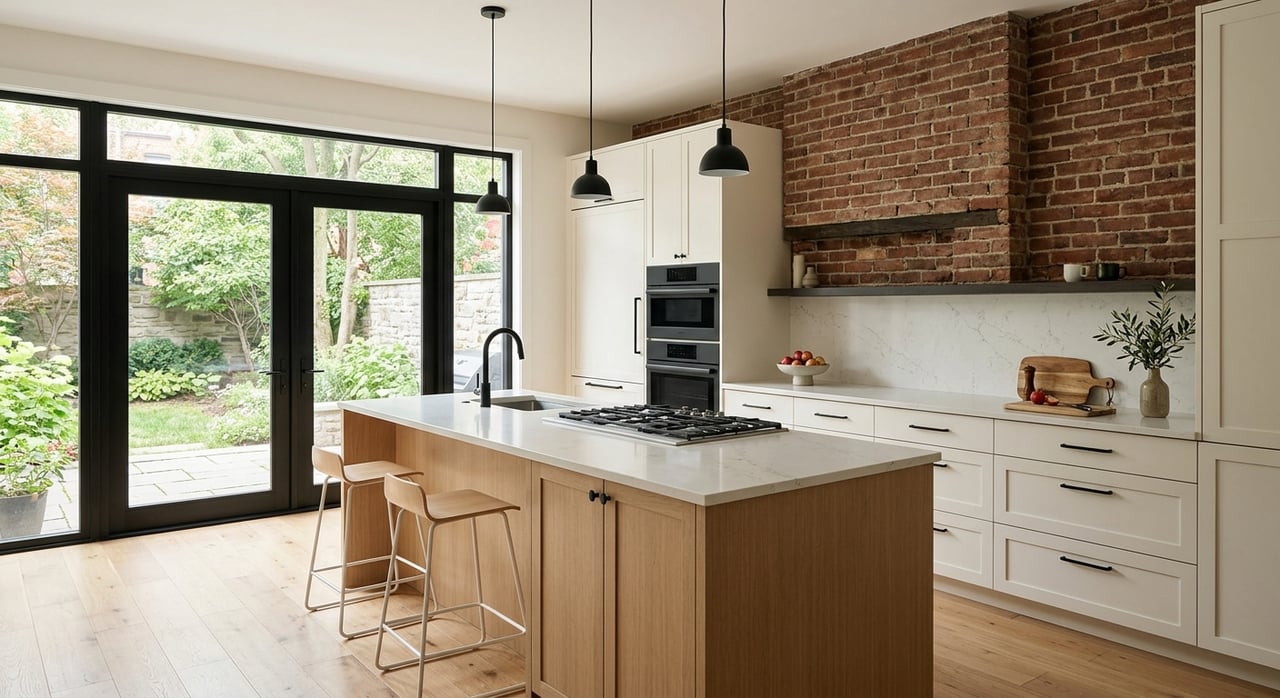
Newer homes in Upper Saddle River tend to compete on convenience, flow, and fewer immediate projects. Current new-construction listings often highlight open-concept layouts, large kitchen islands, main-level offices, first-floor en-suite bedrooms or primary suites, and spa-style baths.
Some newer homes also include features that support easier day-to-day living, such as grade-level garage entry. If you want a home that feels current from day one, newer construction often delivers that without the need to plan major updates right after closing.
There is also an energy-performance difference worth noting. New Jersey’s current construction code adopts the 2021 International Energy Conservation Code for low-rise residential construction, so newer homes are generally built to more recent energy standards than much of Upper Saddle River’s pre-1980 housing stock.
New Builds: Potential Upsides
If you are comparing an older Colonial with a newer build, these benefits often stand out:
- Open layouts with wider sightlines
- More contemporary kitchen and bath design
- Spaces designed for current living patterns, like home offices
- Fewer immediate repair or renovation projects
- More recent energy-code standards
For many buyers, a new build is less about architectural character and more about reducing friction. You are often paying a premium for a more turnkey experience.
New Builds: Common Tradeoffs
The main challenge is supply. Since only a small percentage of the borough’s housing stock is truly recent construction, buyers looking for a new build may have fewer options and more competition.
You may also be paying more upfront for finishes and features that have already been selected and completed. If you prefer to customize over time and control where your renovation dollars go, an older home can sometimes provide a different kind of value.
How To Compare the Two
If you are deciding between older charm and a newer build, focus on your lifestyle first and finishes second. Beautiful photos can pull you in quickly, but the better long-term choice is usually the one that matches how you live and how you want to spend your money.
A simple way to think about it is this: older homes often offer character with future project planning, while newer homes often offer convenience with a higher entry cost. Neither is automatically better. The right choice depends on your timeline, your tolerance for updates, and how much cash you want to keep available after closing.
Ask Yourself These Questions
Use these questions to clarify what matters most:
- Do you want a turnkey home, or are you comfortable updating over time?
- Would you rather pay more now or reserve funds for future projects?
- Do you prefer traditional room layouts or open-concept flow?
- How important are modern energy standards to you?
- Do you have the time and patience for renovation decisions and permit timelines?
These answers can shape your search more effectively than style alone. They also help you avoid stretching for a home that looks right on paper but does not fit your daily life.
Due Diligence Matters in Either Choice
Whether you buy an older home or a newer one, inspections and local permit review matter. In Upper Saddle River, the Building Department states that permits are required for work that constructs, enlarges, repairs, renovates, alters, reconstructs, or demolishes a structure.
The borough also notes that many projects may require zoning, engineering, soil movement, historic, or health review before permit issuance. After zoning approval, inspector approvals can take up to 20 business days. That makes it especially important to understand what was done to a home, whether permits were pulled, and whether final inspections were completed.
Older Homes and Renovation Checks
If you are considering an older property, ask careful questions about past work. Renovated kitchens and baths are appealing, but the real value is in knowing whether updates were done properly and with the required approvals.
For homes built before 1978, lead-based paint should also be part of your inspection conversation. The EPA says older homes are more likely to contain lead paint, and estimates that 24% of homes built between 1960 and 1978 have some lead-based paint. If renovation or repair work disturbs paint in a pre-1978 home, lead-safe practices are important because dangerous dust can be created.
Radon Is Worth Testing Too
Radon is not just an older-home issue. NJDEP places Upper Saddle River in Tier 2, meaning moderate radon potential, and reports that 16% of tested homes were at or above 4 pCi/L.
NJDEP recommends testing all homes, and the EPA notes that any home can have elevated radon levels. A practical starting point is testing the lowest lived-in level or the basement. This is one of those steps that is easy to overlook, but it matters in both older and newer properties.
A Practical Decision Framework
If you love older charm, your winning strategy may be to buy with a renovation reserve in mind. That gives you room to handle insulation, windows, doors, or mechanical improvements over time while still enjoying the home’s character from the start.
If you prefer newer construction, your strategy may be to focus on layout, convenience, and reduced near-term maintenance. In that case, you are likely paying more for a smoother move-in experience and more up-to-date design and efficiency standards.
In Upper Saddle River, that tradeoff is especially relevant because new construction is limited and overall home values are already high. A smart decision is not just about what you can buy. It is about what kind of ownership experience you want after closing.
The best next step is to compare options through both a lifestyle lens and a numbers lens. That means looking beyond finishes and asking what each property may require from you in the first year, the first five years, and beyond.
If you are weighing older charm against new-build convenience in Upper Saddle River, working with a local, data-driven advisor can help you compare inventory, renovation risk, and long-term value with more confidence. To start your search or talk through your options, connect with Jacqueline Vasquez.
FAQs
Is Upper Saddle River mostly older homes or newer homes?
- Upper Saddle River is mostly older housing stock. The borough reports that about two-thirds of homes were built before 1980, while only 21.0% were built in 2000 or later.
Are true new builds common in Upper Saddle River?
- No. Truly new homes are a small share of the market, with just 3.8% of housing units built in 2020 or later.
What does older charm usually mean in Upper Saddle River homes?
- It usually refers to homes such as updated early-1900s front-porch Colonials or classic center-hall Colonials with more traditional layouts, architectural details, and updates completed over time rather than all at once.
What are the benefits of buying a newer home in Upper Saddle River?
- Newer homes often offer open-concept layouts, large kitchen islands, main-level offices, en-suite bedrooms, spa-style baths, and fewer immediate renovation needs. They are also generally built to more recent energy-code standards.
Should Upper Saddle River buyers check permits before buying?
- Yes. The borough requires permits for many types of construction, repair, renovation, and alteration work, and unpermitted work can create safety issues and penalties.
Do older homes in Upper Saddle River need lead paint consideration?
- Yes, especially if the home was built before 1978. Older homes are more likely to contain lead-based paint, so this should be part of your inspection and renovation planning.
Should you test for radon in Upper Saddle River homes?
- Yes. NJDEP recommends testing all homes, and Upper Saddle River is in a moderate radon potential tier, with 16% of tested homes at or above 4 pCi/L.